Botched Mini Face Lift: Causes, Warning Signs, and How to Fix It

Botched Mini Face Lift

A mini facelift is meant to soften jowls, sharpen the jawline, and take years off your reflection with a shorter recovery than a traditional facelift. 

Done well, the change is subtle, and the results look like you, only rested. Done poorly, a botched mini face lift can leave the face pulled, uneven, or scarred in ways that are hard to hide and harder to live with. 

If you are comparing mini facelift before and after photos to your own results, searching for plastic surgery face gone wrong stories to make sense of what happened, or simply trying to recover from a facelift gone bad, this guide breaks down the causes, warning signs, and correction options available today.

What is a mini facelift, and where does it go wrong?

So, what is a mini facelift exactly? 

It is a scaled-down version of a traditional facelift that focuses on the lower third of the face, the jowls, nasolabial folds, and upper neck, using shorter incisions around the ear. It suits patients in their forties or fifties with mild to moderate sagging who are not yet ready for a full facelift. 

Problems start when this smaller procedure treats something it was never designed to fix, such as significant neck laxity that really calls for a full facelift or neck lift. 

A mini lower face lift performed on the wrong candidate, or with a rushed technique, is one of the most common paths to a botched mini face lift.

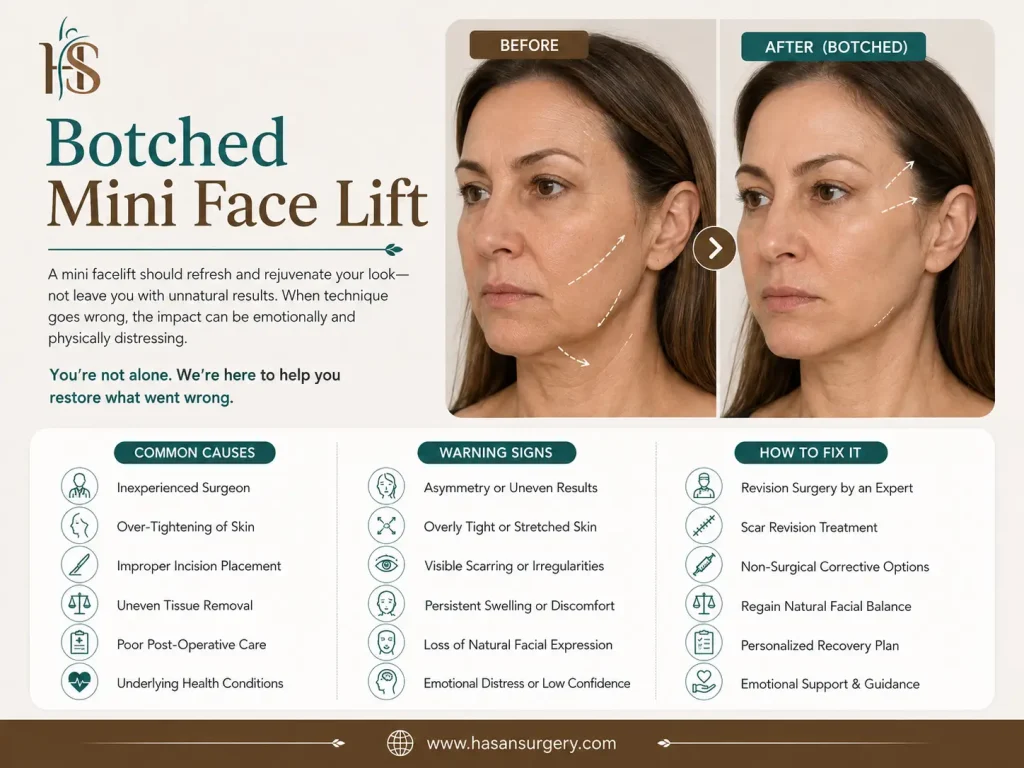
Warning signs of a botched mini face lift

Not every imperfect result is a true complication, but certain signs point clearly to trouble:

  • An unnaturally tight, wind-swept appearance rather than a rested look.
  • A pixie-ear deformity, where the earlobe is pulled downward or fused to the cheek.
  • Visible, thickened, or widened scarring around the ear or hairline.
  • Noticeable asymmetry between the two sides of the face.
  • Skin bunching, dimpling, or an uneven jawline months after healing.
  • Results that relapse within a year or two, rather than lasting several years.
  • A final look that bears little resemblance to the mini-facelift before-and-after photos discussed during the consultation.

Whether you are a 45 year old botched mini face lift patient or someone noticing subtle changes months later, these signs deserve a professional evaluation. 

Patients researching a 45 year old botched mini face lift case often find the same pattern: an inexperienced surgeon and an over-tightened result. 

If several signs apply to you, you may be dealing with bad facelift results that warrant a second opinion. 

Clearing up the botched face meaning behind these terms, rather than assuming the worst, helps set realistic expectations before any correction is planned.

What causes a mini face lift to go wrong?

A botched facelift rarely comes down to one single mistake. More often, it is a combination of factors:

  • Choosing a provider who is not a board-certified plastic surgeon with facelift experience.
  • Being recommended a mini lower face lift when your anatomy needed a more comprehensive procedure.
  • Excessive skin tension or poor incision placement, a leading cause of mini face botched neck lift scars.
  • Superficial technique that lifts skin without repositioning deeper facial tissue, leading to a facelift botched by short-lived results.

Together, these are the ingredients behind most cases of plastic surgery face gone wrong. A botched face lift is almost always preventable with the right surgeon and honest expectations from day one.

The real cost of a botched mini face lift

In most cost botched mini face lift searches, the price is rarely just the original surgeon’s fee. 

Add a second consultation, imaging, a longer recovery, and a full revision procedure, and the total exceeds the first surgery alone. 

A botched facelift usually ends up costing more overall than getting it right the first time. 

Avoiding bad facelift results, and the bad face plastic surgery bills that follow, starts with vetting a surgeon’s credentials before booking the original procedure.

Get a quote.

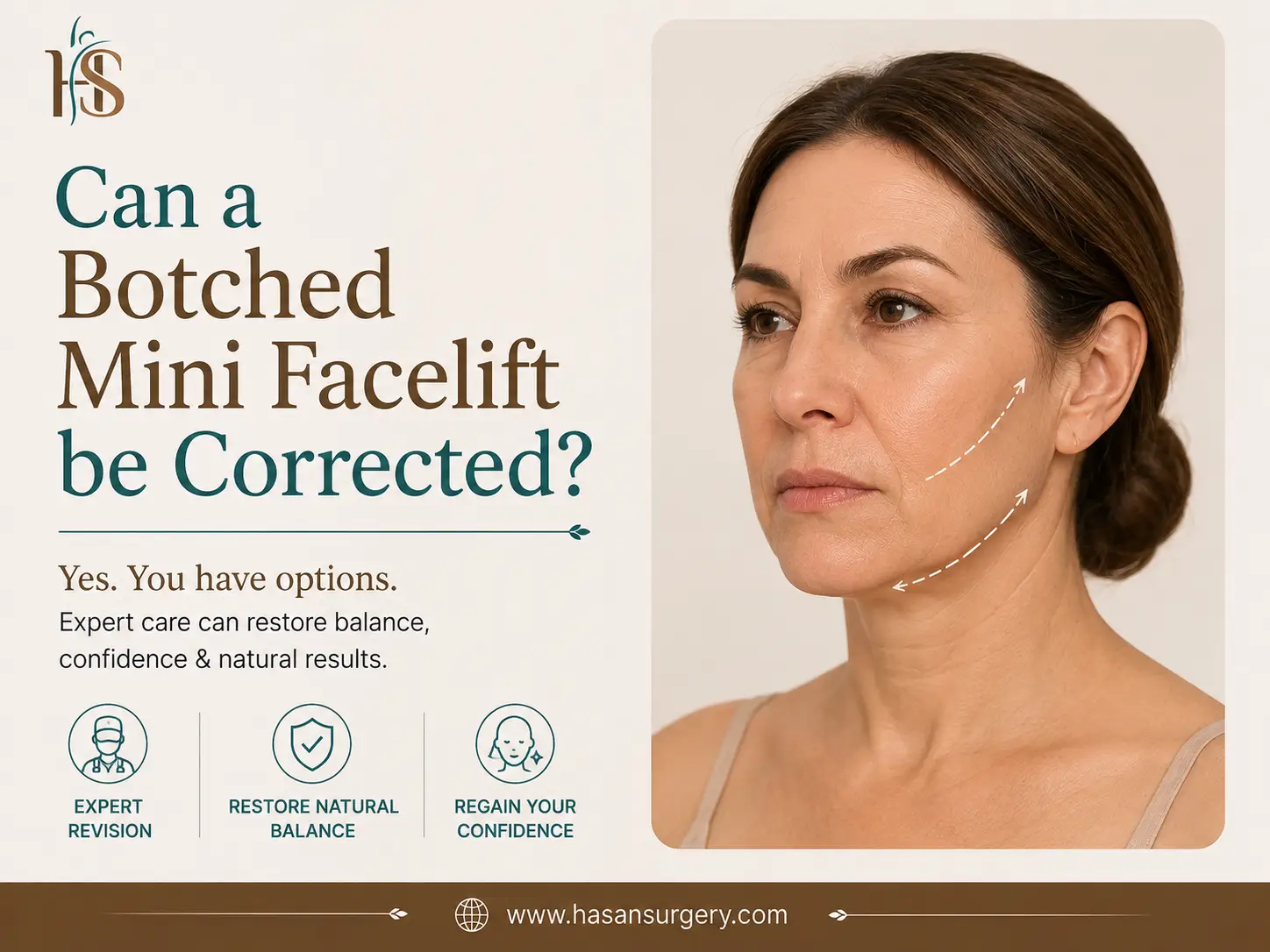
Can a botched mini face lift be corrected?

The encouraging news is that a facelift botched the first time, or a facelift gone bad in any way, can usually be improved with revision surgery. Depending on the issue, correction may involve:

  • Scar revision to soften mini face botched neck lift scars and reposition visible marks.
  • Redraping and re-suspending the skin to release an overly tight, pulled appearance.
  • Deeper tissue correction to fix asymmetry or restore a natural jawline contour.
  • In some cases, converting to a full facelift or neck lift for longer-lasting, balanced results.

Surgeons recommend waiting 6-12 months after the original procedure so tissues can heal completely before planning a revision, as operating too soon can compromise results and stretch out facelift downtime unnecessarily.

Also Read – What Is a Deep Plane Facelift and Its Benefits?

Trust Hasan Surgery for expert care

A botched mini face lift is stressful, but understanding the botched face meaning behind your own results is the first step, not the last. 

At Hasan Surgery, Dr. Hasan Ali brings decades of research-driven, award-recognized plastic surgery experience to every revision consultation, taking the time to understand what went wrong and building a precise plan to correct it properly. 

Book a consultation with Dr. Hasan Ali today.

Dr. Hasan Ali - Best Plastic Surgeon in Dubai

About

Dr. Hasan Ali

Consultant Plastic, Reconstructive & Aesthetic Surgeon
Founder & Medical Director — Hasan Surgery, Dubai Healthcare City

MBBS · MSc Aesthetic Plastic Surgery (Univ. of London) · MRCS (UK) · EBOPRAS (France) · FICS (USA)

20+

Years Experience

10,000+

Contouring Surgeries

2007

VASER Pioneer

Dr. Hasan Ali is recognised as one of the leading body-contouring and VASER liposuction surgeons in Dubai and the UAE, specialising in body lift surgery, 360° contouring, and high-definition body sculpting. He has trained dozens of plastic surgeons in advanced VASER techniques, serves as an international surveyor for AAAASF, and holds active surgical licences across the UK, Ireland, UAE, Saudi Arabia, and Pakistan. His research is indexed on Google Scholar.

Dr. Hasan Ali is an esteemed member of several prestigious international organisations, including the International Society of Aesthetic Plastic Surgery (ISAPS), Emirates Plastic Surgery Society (EPSS), American Society of Plastic Surgeons (ASPS), International College of Surgeons (ICS), American Academy of Cosmetic Surgery (AACS), British Association of Plastic, Reconstructive and Aesthetic Surgeons (BAPRAS), Hair Restoration Surgery Professionals (HRSP), and the Royal College of Physicians and Surgeons of Glasgow. These affiliations reflect his commitment to maintaining the highest standards of patient safety, innovation, and excellence in aesthetic and reconstructive surgery.

Book An Appointment